Best Helmet for Onewheel Racing (2026 Guide): Visibility vs Protection Tradeoffs
Table of Contents
- The Question Most Helmet Guides Get Wrong
- Why Onewheel Is Not the Same as EUC And Why It Matters
- Helmet Safety Standards Explained: What They Test and Why Speed Matters
- MIPS vs. NTA 8776: Two Different Problems, One Helmet Choice
- Full-Face Helmets: Real Benefits, Real Tradeoffs
- NTA 8776 Open-Face Helmets: The Racing Case
- The Most Overlooked Safety Factor: Reaction Time
- My Personal Racing Experience
- Choosing the Right Helmet for Your Riding Style
- Frequently Asked Questions
- Final Thoughts
The Question Most Helmet Guides Get Wrong
Search for the best helmet for Onewheel racing, and you will find the same advice everywhere: wear the most protective helmet possible. It sounds responsible. But for experienced Onewheel racers, that advice misses half the equation.
Protection and awareness are not the same thing. At racing speeds, the helmet that keeps you safest is not always the one with the most coverage; it is the one that lets you read the terrain, react in time, and recover from a fall rather than absorb the impact.
This guide is written from years of Pro Division Onewheel racing experience, including competition at speeds exceeding 33 mph at night. It is not about selling a philosophy. It is about helping you understand the real tradeoffs so you can make the right call for how you ride.
Quick Answer: For Onewheel racing, an NTA 8776-certified open-face helmet like the Xnito offers the best balance of higher-speed protection, extended head coverage, and full visibility. Full-face helmets add jaw protection but reduce the downward sightlines Onewheel riders depend on.
Why Onewheel Is Not the Same as EUC And Why It Matters
One of the most persistent problems in Onewheel helmet advice is that Onewheel riders get lumped together with EUC (electric unicycle) riders. The gear recommendations that follow from that grouping are often wrong for Onewheel-specific crash dynamics.
How Onewheel Riders Fall
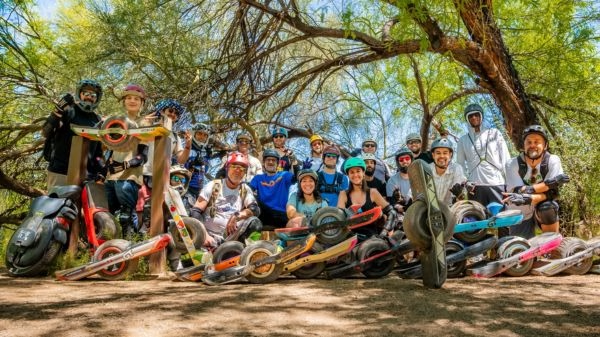
Onewheel riders stand sideways, carving heel-to-toe. Falls tend to be diagonal and dynamic, a mix of forward momentum and lateral rotation. In many cases, especially for experienced riders, falls are partially recoverable: you run it out, roll, or redirect. When the head does make contact, it is most often the side or back of the helmet that takes the hit, not the face.
How EUC Riders Fall
EUC riders stand forward-facing and travel in a straight line. At the speeds EUC racing reaches often significantly higher than Onewheel a loss of control tends to be a direct forward ejection. Recovery is less likely. The face and front of the head are in greater danger. This is why full-face and even motorcycle-grade helmet recommendations make sense for EUC racers: the risk profile genuinely calls for frontal protection.
Onewheel riders who follow EUC-specific helmet advice end up accepting significant visibility tradeoffs for protection against a crash type that is actually less common in their discipline.
Helmet Safety Standards Explained: What They Test and Why Speed Matters
Every helmet certification is built around a set of assumed impact conditions, including speed. A helmet does not simply “fail” if you ride faster than its design range, but it is optimized for a specific window of impact energy. Understanding that window helps you choose protection that actually matches how you ride.
Helmet Safety Comparison
Standard | Speed Intent | Key Strength | Onewheel Relevance |
CPSC / ASTM | Up to ~20 mph | Widely available, lightweight | Below racing speeds not recommended solo |
NTA 8776 | Up to 28 mph | Higher impact energy + extended coverage | Best match for PEV and Onewheel racing |
ASTM F1952 (DH MTB) | Higher terrain impacts* | Full-face option, chin bar tested | Good protection, lower visibility tradeoff |
DOT / ECE / Snell (Moto) | 40+ mph | Maximum impact protection | Overkill for most riders; heavy and restrictive |
* ASTM F1952 does not carry an official mph rating. The standard is defined by drop height and joule energy levels. The “higher terrain impacts” characterization reflects the standard’s intent for aggressive downhill MTB scenarios.
The Physics Behind the Standards
Impact energy does not scale linearly with speed it grows much faster. A rider hitting pavement at 30 mph experiences dramatically more energy transfer than one falling at 15 mph. This is why standard CPSC-certified skate and bike helmets, tested for impacts up to roughly 20 mph, are meaningfully outmatched at Onewheel racing speeds.
NTA 8776 was developed specifically to close this gap. It is not a minor upgrade it mandates a significantly lower test line on the sides and rear of the helmet, meaning more coverage is actually tested, not just present. It was designed with powered electric vehicles in mind, and it remains the most relevant certification standard for Onewheel racing today.
MIPS vs. NTA 8776: Two Different Problems, One Helmet Choice
This is one of the most misunderstood comparisons in the PEV helmet space. MIPS and NTA 8776 are not competing features. They address entirely different aspects of head protection and the best scenario is having both.
What MIPS Does
MIPS (Multi-directional Impact Protection System) addresses rotational force. Most real-world crashes involve angled impacts, not straight vertical drops. When your head hits at an angle, the brain experiences a twisting motion that standard foam liners are not designed to manage. MIPS adds a low-friction slip layer inside the helmet that allows approximately 10 to 15mm of independent movement, redirecting some of that rotational energy away from the brain.
What MIPS does not do: it does not increase impact energy absorption, it does not extend helmet coverage, and it does not make a helmet suitable for higher speeds. It is a rotational injury mitigation technology, not a speed rating upgrade.
What NTA 8776 Does
NTA 8776 is a certification standard, not a technology. It defines how much impact energy a helmet must absorb, how far down the sides and rear the protection must extend, and under what conditions the helmet is tested. A helmet that passes NTA 8776 has been validated for the speed range and impact zones most relevant to PEV riding.
Why You Want Both and Why NTA Is the Priority
For Onewheel racing, NTA 8776 addresses the most critical gaps: speed-appropriate impact protection and coverage in the zones where real crashes happen. MIPS adds meaningful value on top of that by addressing the rotational dynamics of angled falls common to Onewheel riding. But MIPS alone, added to a standard CPSC helmet, does not provide the impact energy capacity or coverage that NTA provides.
Helmet Protection Comparison
Feature | MIPS | NTA 8776 | Full-Face MTB |
Rotational protection |  Yes Yes | Partial | Partial |
Higher-speed impact rating |  No No | Yes (28 mph) | Moderate |
Extended temple/rear coverage | No | Yes | Yes |
Face/jaw protection | No | No | Yes |
Full downward visibility | Yes | Yes |  Reduced Reduced |
Lightweight (racing practical) | Yes | Yes | Moderate |
Designed for PEV speeds | No | Yes | No |
Full-Face Helmets: Real Benefits, Real Tradeoffs
Full-face helmets are often presented as the obviously safer choice. The reality is more nuanced, especially for Onewheel.
The Case For
If you experience a direct forward impact, a chin bar can prevent serious facial injury, broken teeth, jaw fractures, and road rash on the face. For new riders or those riding unfamiliar terrain at high speed, that protection has real value. Full-face MTB helmets are also significantly lighter than motorcycle helmets, making them more practical for extended sessions.
The Tradeoffs
Reduced downward visibility. Onewheel riding is heavily dependent on reading the terrain below you, roots, cracks, grade changes, and loose surfaces. A chin bar narrows your lower field of view and requires more deliberate head movement to compensate. At racing speeds, that fraction of a second matters.
Altered impact dynamics. In the angled, sliding falls typical of Onewheel, a chin bar can catch the ground rather than slide across it, creating a more abrupt rotational stop. This can transfer stress into the jaw and neck in ways a smooth open-face helmet would not.
Structural limitations. Most riders use lightweight MTB full-face helmets rather than motorcycle-grade gear. The chin bars on these helmets are lighter and less rigid than they appear. Protection is real, but should not be assumed equivalent to moto-grade coverage.
Performance cost. Additional weight and reduced airflow contribute to fatigue over long or hot sessions. In racing, fatigue affects decision-making, which is itself a safety factor.
The question is not whether full-face helmets offer more protection. They do for specific impact types. The question is whether that specific protection outweighs the visibility and dynamics tradeoffs for how Onewheel crashes actually happen.
NTA 8776 Open-Face Helmets: The Racing Case
High-coverage open-face helmets built to NTA 8776 represent a different philosophy: maximize what you can see and control while ensuring the protection present is properly rated for your actual riding speed.
What Makes NTA Helmets Different
- Extended coverage at the temples and rear areas is where Onewheel riders most commonly make contact
- Tested for impact energies appropriate to 28 mph riding, not 15 to 20 mph assumptions
- Open-face design preserves full peripheral and downward visibility
- Lighter weight supports dynamic fall recovery running out, rolling, redirecting
The Xnito: Purpose-Built for PEV Riders
When NTA 8776 helmets first entered the market, the Xnito was the standout option, purpose-designed for electric personal vehicles, not repurposed from an e-bike commuter context. For Onewheel racing specifically, it remains the top recommendation for several reasons:
- NTA 8776 certified, validated for speeds up to 28 mph
- Weighs just 0.83 lb (376g) among the lightest NTA-certified options
- Open design with 10 vents maintains airflow during high-output racing
- Extended temple and rear coverage aligned with real Onewheel crash zones
- Integrated front and rear LED lights are relevant for night riding and low-light sessions
- Magnetic FIDLOCK buckle for one-handed operation, including with gloves
- Lifetime accident replacement warranty
The NTA 8776 Field Has Grown
Since Xnito pioneered NTA certification in the PEV space, other brands have followed. The Giro Camden MIPS, Specialized Mode, Bern Hudson, ABUS Pedelec 2.0, and UNIT 1 AURA (which also carries a Virginia Tech 5-star rating) are now NTA 8776-certified. Most are designed with e-bike commuters in mind rather than PEV racers, but they are valid options if their fit or features better align with your preferences.
The Xnito remains the recommendation here because of its specific design intent, weight, and fit characteristics for active PEV riding rather than upright commuting, but the field is worth knowing.
The Most Overlooked Safety Factor: Reaction Time
There is a principle that experienced racers learn early and that almost no helmet guide talks about:
Preventing a crash usually does more for your safety than surviving one better. Awareness is your first line of defense. Visibility directly determines awareness.
At 30+ mph, the window between noticing a terrain change and reacting to it is measured in fractions of a second. A helmet that narrows your field of view even slightly shifts more of your attention toward compensation: more deliberate head movement, more cognitive load, more fatigue. All of that erodes the margin that keeps you on the board.
This does not mean open-face helmets are always the right call for every rider. It means visibility is a genuine safety variable, not just a comfort preference, and it deserves real weight in your decision.
My Personal Racing Experience
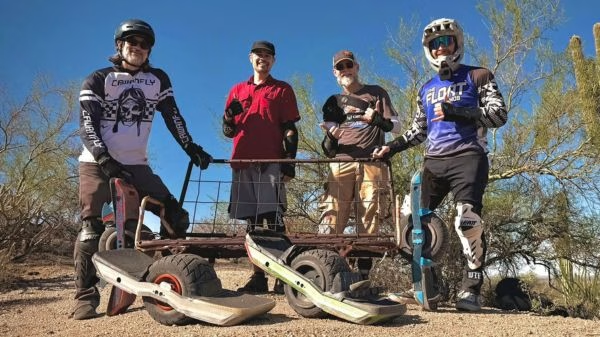
My perspective on this topic is shaped by years spent in the competitive Onewheel scene, not by armchair analysis.
- Let It Ride 1 and 3 Pro Division
- Seek and Shred 2 Pro Division
- Onewheel AZ Underground races with consistent top-5 finishes over four years
- Sustained racing speeds of 33+ mph, including night events
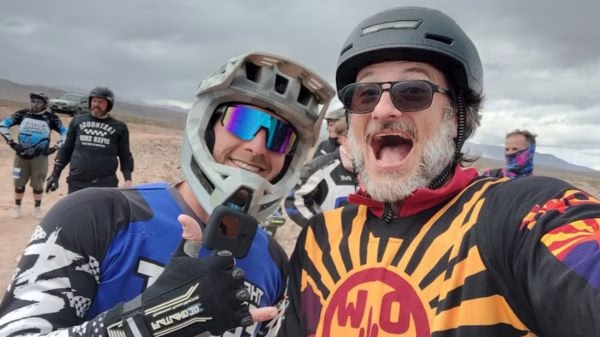
In that experience, I have never felt the need for a full-face helmet. More than that, reduced visibility has consistently felt like a competitive and safety disadvantage, not a tradeoff I was willing to accept. In the crashes I have had, the contact points were the side and back of my helmet, not my face.
That is one data point, not a universal rule. But it is an honest account of what high-level Onewheel racing actually looks like, and it shapes my choice of the Xnito. See my full review of why I think the Xnito is the best Onewheel helmet available.
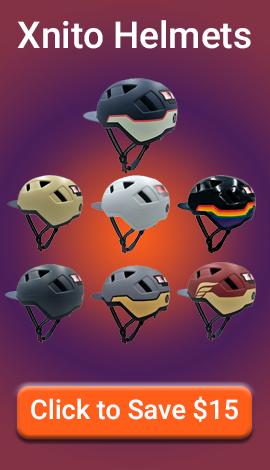
Xnito Helmet Discount
Save 15$ with our Community Link
Choosing the Right Helmet for Your Riding Style
For Racing and High-Performance Riding
Prioritize visibility, terrain awareness, and NTA 8776 certification. An open-face helmet with extended side and rear coverage, such as the Xnito, is recommended. If your riding includes low-light or night sessions, integrated lighting is not a luxury; it is a meaningful safety feature.
For Mixed Conditions and Group Riding
Some riders keep both options and alternate based on session type: open-face for performance riding on known terrain, full-face for unfamiliar routes, higher-risk environments, or sessions where fatigue is a factor. That is a reasonable approach and does not require committing entirely to one philosophy.
For Maximum Protection Priority
If worst-case scenario protection takes priority over all other factors, for a new rider, very high speeds, pavement-focused riding, a full-face MTB helmet, or even a light motorcycle helmet is the logical choice. Accept the visibility and performance tradeoffs consciously, not by default.
Frequently Asked Questions
Is an NTA 8776 helmet required for Onewheel riding?
No, there is no legal requirement. But for riders regularly exceeding 20 mph, it is the most appropriate standard available. Standard CPSC helmets were not designed for the impact energies common at Onewheel racing speeds.
Can I use a skateboard helmet for Onewheel racing?
Skate helmets are designed for repeated low-speed impacts, not high-speed single-impact events. They offer meaningful protection at casual speeds but fall short of the design spec for racing use. An NTA 8776 helmet is a better fit for high-performance riding.
Does MIPS make a helmet safe enough for racing?
MIPS improves rotational force management but does not upgrade a helmet’s impact energy rating or coverage area. A CPSC-certified helmet with MIPS is still a CPSC-level helmet for speed. For racing, the NTA 8776 standard addresses the gaps that matter most; MIPS is a valuable addition on top of that.
What about motorcycle helmets for Onewheel?
Motorcycle helmets provide the highest level of impact protection available and are designed to withstand impacts at 40+ mph. The tradeoffs are significant: heavier weight, reduced airflow, and greatly limited peripheral and downward visibility. For most Onewheel racing scenarios, they introduce more problems than they solve.
Are there NTA 8776 helmets other than the Xnito?
Yes. The field has expanded to include the Giro Camden MIPS, Specialized Mode, Bern Hudson, ABUS Pedelec 2.0, and UNIT 1 AURA, among others. Most are designed with commuter e-bike use in mind. The Xnito remains the recommendation for active PEV racing due to its weight, design intent, and fit characteristics.
Final Thoughts
There is no single best helmet for Onewheel racing, but there is a right set of tradeoffs for your riding style, speed, and conditions. What this guide argues is that those tradeoffs deserve to be made consciously, with an accurate understanding of what each choice actually does and does not provide.
The core principles:
- Onewheel crash dynamics differ from EUC; helmet advice should reflect that
- NTA 8776 is the most appropriate standard for racing speeds
- MIPS and NTA solve different problems; both matter, and NTA is the priority
- Visibility is a safety variable, not just a comfort preference
- Full-face helmets offer specific benefits for specific crash types, not universal superiority
For most experienced Onewheel racers, the goal is the same: maximize awareness first, then layer in protection without compromising it. That is where informed helmet decisions live.
Written from active Pro Division Onewheel racing experience. Always verify current certifications with manufacturers before purchasing.
Onewheel AZ News